
Buying Commercial Real Estate in Baton Rouge: A Complete Guide
Buying commercial real estate in Baton Rouge is not buying a house with a bigger parking lot. But before you get anywhere near due diligence or financing, answer one question honestly: are you buying a building to run your business out of, or are you buying an income stream that happens to come with a roof? Those are two different purchases with two different playbooks, and most of the trouble I see starts with buyers who never sorted out which one they are. This is the guide I wish every first-time buyer read before they called me, owner-occupant or investor, and a decent refresher for the ones who have done it before.
Owner-Occupant or Investor? Know Which One You Are

An owner-occupant buys the building to run their own business out of it. A dentist buying her office, a distributor buying a warehouse, a restaurant group buying the building it operates in. The building is a tool, not a return. The math that matters is simple: what does owning cost per month against what leasing would cost, and what do you walk away with when you sell.
A first-time investor buys the building for the income the tenants pay, whether the buyer ever sets foot in it or not. The building is the product. The math that matters is the cap rate, the tenant's credit, and the lease terms protecting that rent roll.
Same closing table, completely different underwriting. Read the rest of this with your kind of buyer in mind, because I will flag where the two split.
Start With the Asset Type
If you are an owner-occupant, the asset type mostly picks itself. You need office, industrial, or retail space that fits how your business actually operates, and the real decision is buying versus leasing that space, not which food group of real estate to chase. If you are an investor, you are choosing a business model, because commercial is not one market, it is four sitting under one word. NNN retail is the closest thing to mailbox money: a tenant on a long lease pays the taxes, insurance, and maintenance, and you collect. Office is a management job and a leasing job, and post-Covid it is a buyer's negotiation. Industrial is the tightest market in the Capital Region, driven by the Port of Greater Baton Rouge and the plants along the river. Land is the patient money. Decide which business you actually want to be in before you fall in love with a building.
How Commercial Deals Get Priced
For investors, one number runs this business: the cap rate. Take the property's net operating income, the rent left after operating expenses, and divide it by the price. That is the yield you buy at. Lower cap rate means a higher price and lower risk. Higher cap rate means a cheaper price and more hair on the deal.
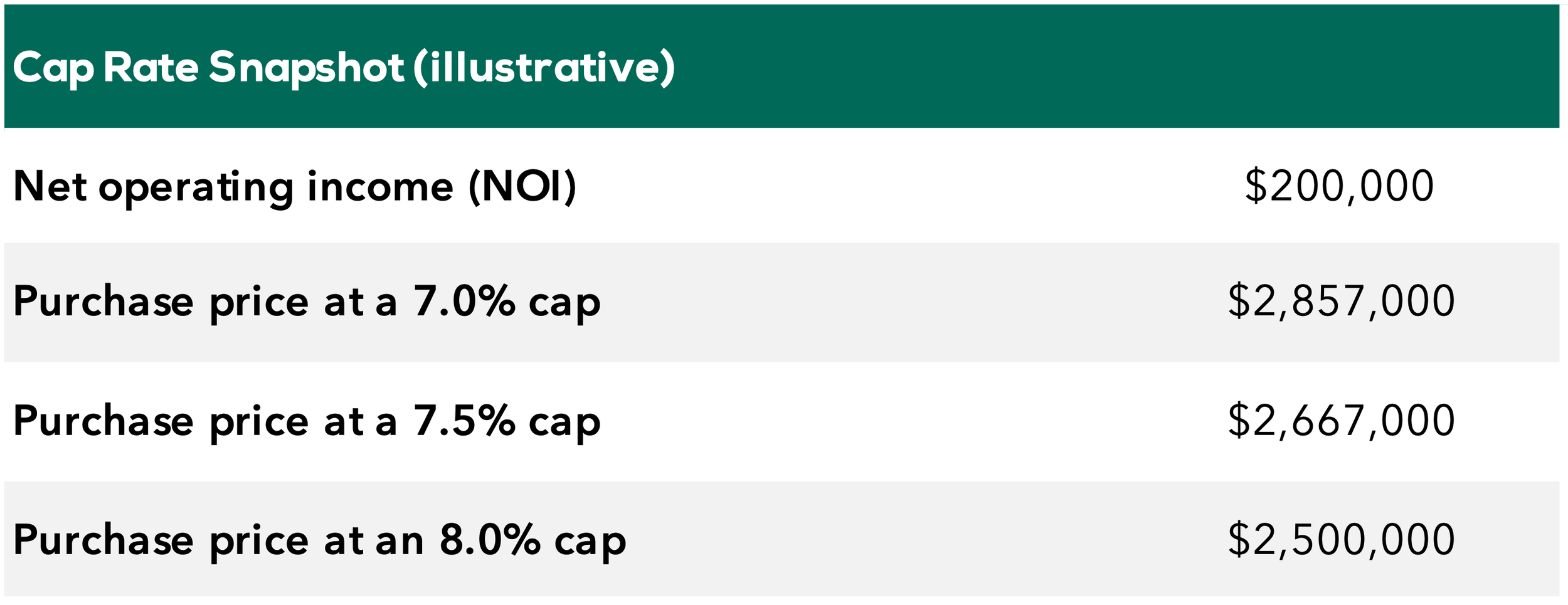
A half point of cap rate on a $200,000 NOI is roughly $190,000 in price. That is why the argument in every investment deal is really an argument about one decimal place.
Owner-occupants should still know the cap rate on comparable sales, because it tells you what an investor would pay for your building if you ever sell it. But your real number is occupancy cost per square foot against what you would pay to lease the same space. If owning costs less once you account for principal paydown and appreciation, buy. Do not buy a building just to say you own real estate.
The Buying Process, Step by Step
The path is predictable. You get pre-qualified with a lender or line up your equity. You tour and underwrite, which means you build a real pro forma, not the seller's. You make an offer, usually a letter of intent, then a purchase agreement. You post a deposit and open a due diligence period. Then you inspect, finance, and close. In Baton Rouge, plan on 60 to 90 days from accepted offer to closing on a financed deal. Cash buyers move faster, which is exactly why they win contested deals. If you are exchanging out of another property, the clock is even tighter, and our guide to the 1031 exchange in Louisiana walks through the deadlines. If you are an owner-occupant financing with SBA, add time on the front end. The SBA underwrites your business, not just the building, so expect the lender to ask for two to three years of financials before they ever ask about the roof.
Due Diligence Is Where You Make Your Money

The price is set at the offer. The profit, or the mistake, is protected in due diligence, and what you are checking depends on which buyer you are. Investors: read every lease. Do not take the rent roll's word for it. Verify the income, the expenses, and the CAM reconciliations. Owner-occupants: verify that zoning, parking count, and building code actually support how you plan to use the space, because a building that looks perfect on a drive-by can fail your certificate of occupancy. Both buyers order a Phase I environmental, which is non-negotiable in a market with our industrial history, and both get a survey, a title commitment, and a roof and mechanical inspection. The rent roll or the floor plan is the seller's story. Due diligence is you fact-checking it before you wire the money.
Financing the Deal
The path narrows fast depending on which buyer you are.
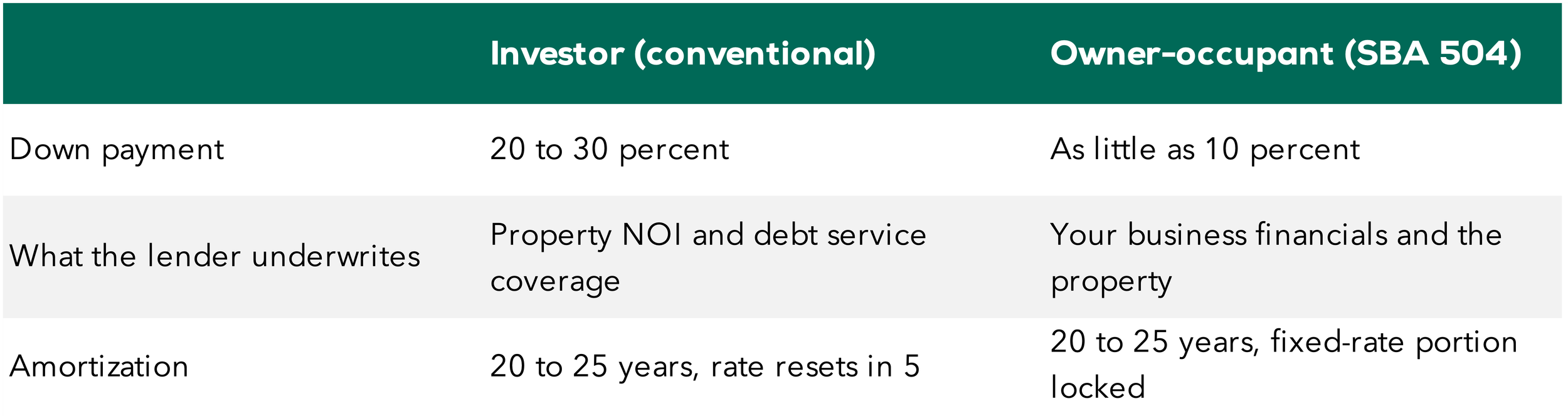
Investors typically finance with a local or regional bank at 70 to 80 percent loan to value. The bank cares about the property's debt service coverage first and your balance sheet second. Owner-occupants have a better option in SBA 504 financing, which can get you in for as little as 10 percent down. The tradeoff is the SBA underwrites your business as closely as the building, so have your financials ready, not just a good appraisal.
The Louisiana Wrinkles

Every state has its quirks. Louisiana has more than its share, because we run on the Napoleonic Code while everyone else runs on common law. A few that matter to buyers, occupant or investor alike. We have servitudes, not easements, and they can sit on a title quietly until they cost you a building pad. We are a community property state, so married sellers usually both have to sign. Flood zones are real money here. The difference between Zone X and Zone AE can swing your insurance by five figures a year, so pull the flood determination early. And assessments can reset on sale, so underwrite the taxes you will pay, not the taxes the seller pays.
The Bottom Line
Buying commercial real estate in Baton Rouge rewards the prepared and punishes the casual, whichever buyer you are. If you are an owner-occupant, run the real math against leasing, get your zoning and use nailed down early, and let SBA 504 work for you. If you are an investor, underwrite the income yourself, do not take the seller's rent roll on faith, and buy the cap rate you can defend, not the one on the flyer. Either way, line up financing before you fall in love, and respect the Louisiana wrinkles, because the title issue you ignore becomes the lawsuit you fund.
We do this every day, on both sides of the table, for owner-occupants buying their first building and investors buying their first NNN deal. If you are looking at buying commercial real estate in Baton Rouge or anywhere in South Louisiana, and you want the numbers underwritten straight, call us at (225) 408-6595. Momentum Commercial Real Estate, 9420 Old Hammond Hwy, Baton Rouge, LA 70809.