
Tenant Improvement Allowances Explained: How Much You'll Get and How to Negotiate It
Our piece on delivery conditions covered what condition your space shows up in, as-is, shell, or turnkey, and mentioned the TI allowance without stopping to explain it. Time to fix that. The tenant improvement allowance is one of the biggest levers in any lease negotiation, and most tenants either do not ask for enough of it or do not understand what it is actually buying them. Here is how it works, what it is worth right now in Baton Rouge, and how to get more.
What a TI Allowance Actually Is

A tenant improvement allowance is money the landlord contributes toward building out your space, expressed as dollars per square foot. It is not a check that lands in your account. Standard practice is the landlord funds it as reimbursement against paid invoices and lien waivers, or pays your contractor directly on a draw schedule as the work completes. Either way, you are fronting the cash flow and getting made whole, not receiving a grant up front. Build that into your construction budget before you sign, not after your contractor sends the first pay application.
TI vs. Delivery Condition: They Are Not the Same Thing

This is where our delivery conditions article left off, and it is the single most confused distinction in tenant buildouts. Delivery condition is what the landlord hands you, as-is, vanilla shell, warm shell, or turnkey. TI allowance is what the landlord pays toward what you build after that. A generous TI on a raw shell can cost you more out of pocket than a modest TI on a warm shell, because you are paying for slab, walls, ceiling grid, and rough-in MEP before a single finish goes in. Never compare two TI numbers without first comparing what condition the space is in when you get the keys. That comparison is the whole ballgame, and it is where tenants leave the most money on the table.
What TI Typically Covers
Interior finishes are the core of it: flooring, paint, ceiling tile, interior partitions, millwork, lighting fixtures, and typically your share of permitting and architectural fees tied to the buildout. Signage is sometimes included and sometimes carved out, read the lease. FF&E, your furniture, equipment, and anything not permanently affixed to the building, is almost never in TI. If your concept needs specialized infrastructure, a grease trap, a walk-in cooler, reinforced flooring, negotiate that specifically. Landlords will not volunteer it.
What It Is Worth Right Now in Baton Rouge
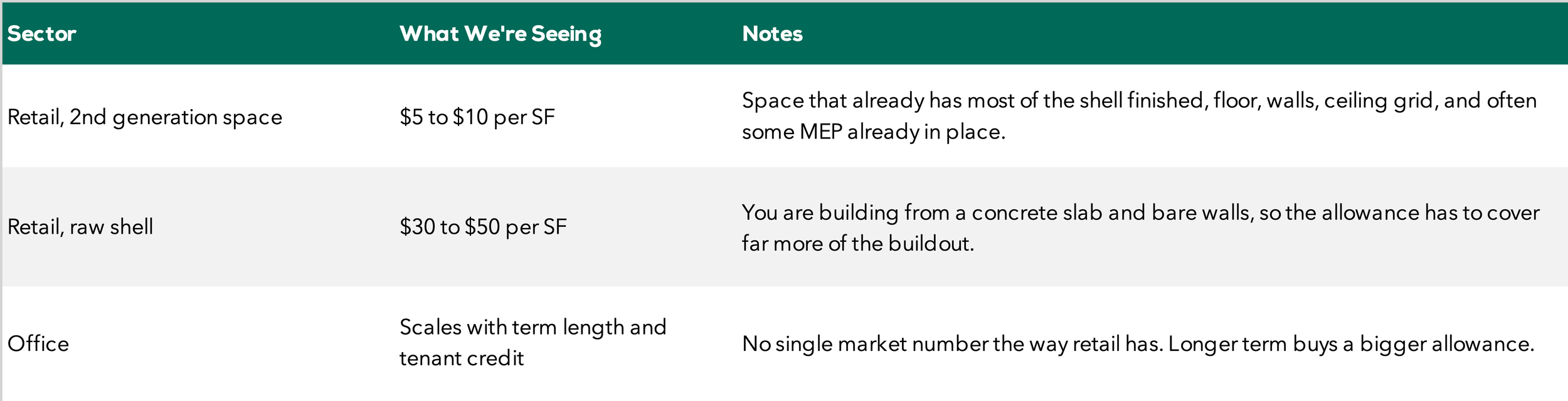
Notice that the retail range depends entirely on what condition the space is in when you get it, which is exactly the point of the last section. A landlord offering $8 per square foot on solid 2nd generation space and one offering $35 per square foot on a raw shell can both be quoting you a fair deal. Office and industrial TI move case by case, driven by term length, tenant credit, and how badly the landlord wants you in that particular building. Do not let anyone quote you a number as market standard without first asking what condition the space was in.
Cash Allowance or Amortized TI: Know Which One You Are Getting
Some landlords write you a straight cash allowance. Others will fund a bigger number but amortize the excess into your rent over the term, essentially loaning you the difference at an interest rate baked into the lease. Both can be fair deals. Neither is free money. Run the math on the amortized version like you would any loan, know the effective rate, and compare it to what you would pay to finance the buildout yourself. And read the unused-TI language closely. Most leases forfeit whatever you do not spend. Negotiate for unused TI to apply as a rent credit instead. It rarely costs the landlord anything to agree to it, and it is money you would otherwise hand back.
How to Negotiate More of It

Term length is the biggest lever you control. Landlords amortize TI across the life of the lease, so a longer term buys a bigger allowance almost every time. Tenant credit matters too, a national credit tenant gets a different number than a first-time operator, that is just underwriting. Leverage is the other half of the equation, and it is not theoretical. A landlord who knows you are seriously looking at two other buildings negotiates differently than one who thinks you are already committed. That is not a trick, it is a market working the way it is supposed to, and it is the same leverage a tenant representation broker builds into every negotiation before the landlord ever sees your name on a term sheet.
The Bottom Line
A TI allowance is a number, but it is not the number. Compare it against the delivery condition, know whether it is cash or amortized, negotiate the unused-TI language before you need it, and use term length and real leverage to push it higher. Get those four things right and the allowance actually does its job: it gets you into a finished space without writing a check you did not plan for.
Talk buildout economics with Momentum: (225) 408-6595 | momentum-commercial.com
Charlie Colvin is a CCIM and Principal at Momentum Commercial Real Estate in Baton Rouge. Momentum's commercial brokerage team handles leasing, sales, and tenant representation throughout Baton Rouge and South Louisiana. TI ranges reflect current deal