
The 1031 Exchange in Louisiana: How Commercial Real Estate Investors Actually Use It
The IRS does not hand out many gifts. Section 1031 is one of them. A 1031 exchange lets a commercial real estate investor in Louisiana sell an investment property, roll the full proceeds into a like-kind replacement, and defer the capital gains tax that would otherwise come due at closing. Federal and state, both z. We published our earlier 1031 primer on the basic mechanics a few years back, and the mechanics have not changed. What deserves its own article is how investors actually use the tool, what the deferral is worth in real dollars, and where exchanges go to die.
What a 1031 Exchange Actually Does
First, the honest framing: a 1031 exchange defers tax, it does not eliminate it. Your basis in the old property carries into the new one, and the deferred gain rides along with it. Sell the replacement property for cash someday and the bill comes due.
So why does every serious real estate investor use it? Two reasons. One, deferred tax is interest-free capital. Money that would have gone to the government stays in the deal as equity, compounding for you instead. Two, the deferral can become permanent. Keep exchanging until you die and your heirs receive the property at a stepped-up basis, and the deferred gain is wiped out entirely. The industry calls this strategy swap till you drop. Estate attorneys call it Tuesday.
The Math That Gets Investors' Attention
Numbers beat adjectives. Take an investor selling a retail center in Baton Rouge. Assumptions: top federal capital gains bracket at 20%, net investment income tax applies, depreciation recapture taxed at 25%, and Louisiana's flat 3% individual income tax, in effect since January 1, 2025.
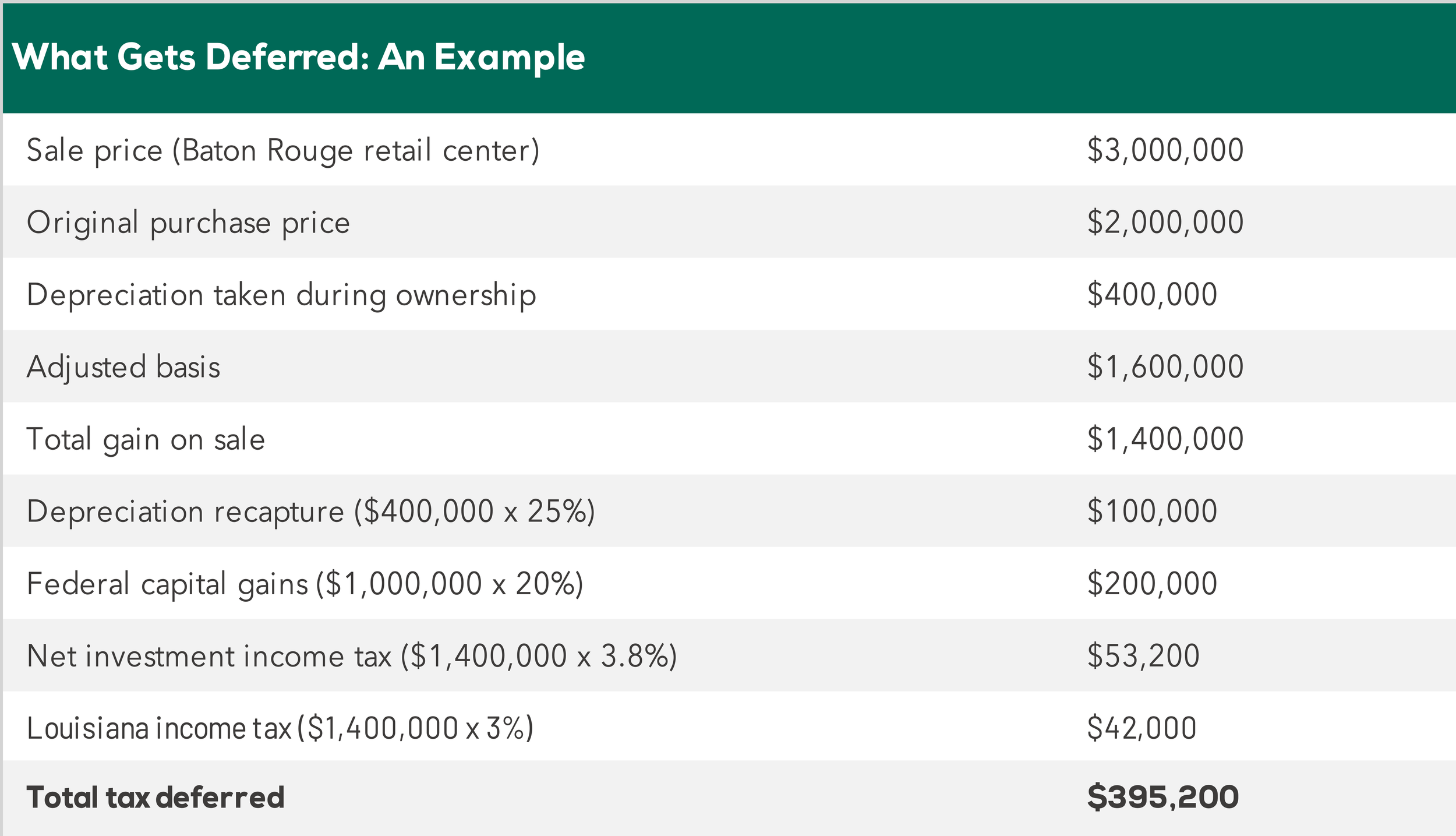
That is $395,200 that either goes to Washington and Baton Rouge, or stays in the deal as equity in your next property. At 65% leverage, that deferred tax is north of $1.1 million in additional buying power. Your CPA will run your actual numbers, and should, before you list.
The Rules, Briefly
The qualification rules are short and strict. Both the property you sell and the property you buy must be real property held for investment or business use. Since the 2017 tax act took effect, real estate is the only asset class that still qualifies. Your primary residence never did.
Like-kind is broader than the name suggests. A retail center for raw land, an office building for an industrial warehouse, a management-heavy strip for a single-tenant NNN deal. All like-kind. If it is investment real estate for investment real estate, you are in the fairway.
To defer the full gain, buy replacement property of equal or greater value, reinvest all of the proceeds, and replace any debt you pay off. Any cash you pocket is boot, and boot is taxable. And the cardinal rule: you never touch the money. A qualified intermediary (QI) must hold the proceeds from the day you close the sale until the day you close the purchase, and the QI must be engaged before your sale closes. The IRS publishes the full requirements on its like-kind exchange page.
The Clock Is the Whole Game
Two deadlines run concurrently from the day your sale closes. You have 45 calendar days to identify your replacement property in writing to your QI, and 180 calendar days to close on it. Weekends and holidays count. There are no extensions except for federally declared disasters, a category South Louisiana knows better than it would like. Day 46 with no identification letter is not a delay. It is a taxable event.
Identification follows one of three rules:
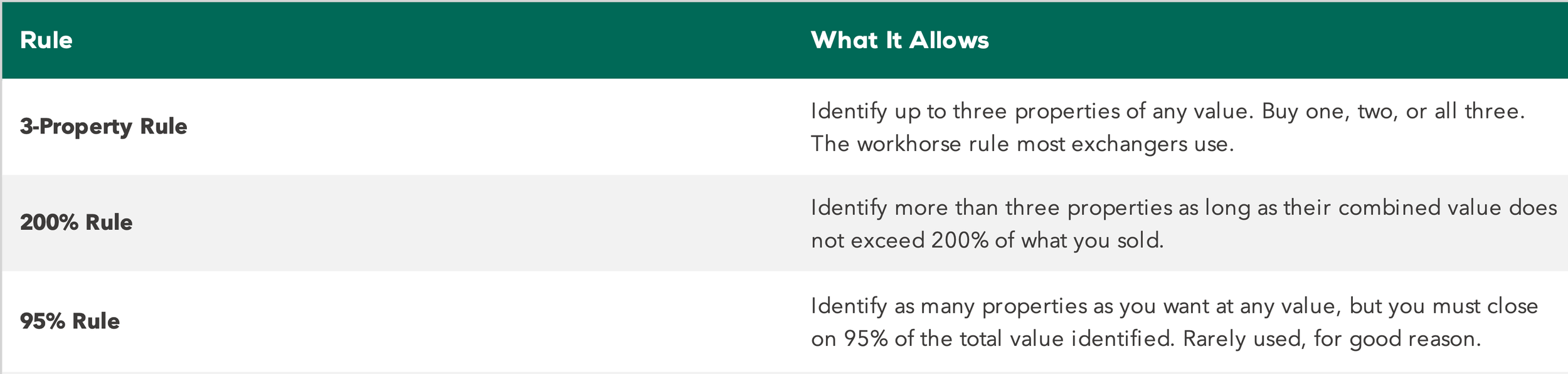
The practical takeaway: 45 days is not a shopping window, it is a paperwork deadline. The investors who win at this start hunting replacement property before they list, not after they close. If your target is Baton Rouge product, our guide to retail space for lease in Baton Rouge and the Summer 2026 Baton Rouge commercial real estate market update show you the field.
The Louisiana Angle

Retail investment property in Prairieville, Louisiana acquired through a 1031 exchange
Louisiana keeps this simple, which is not a sentence you get to write about Louisiana taxes very often. The state fully conforms to federal Section 1031. A qualifying exchange defers your Louisiana income tax right alongside the federal, with no state-specific filings or hoops. Louisiana also has no clawback rule, unlike California, which tracks deferred gains for years after you exchange out of the state. And since January 1, 2025, Louisiana taxes capital gains as ordinary income at a flat 3%, per the Louisiana Department of Revenue.
Two local wrinkles worth knowing. Louisiana is a community property state, so if the property was acquired during a marriage, plan on both spouses participating in the exchange. And 1031 money is a real force in our local market: out-of-state exchangers on a 45-day clock are a meaningful share of the buyers competing for NNN retail product in Baton Rouge. If you have ever wondered why a single-tenant pharmacy trades at a cap rate that makes you squint, the answer is usually a 1031 buyer with a deadline.
How Investors Actually Use It
The textbook case is deferral. The real-world cases are strategy. The most common trade we see in Baton Rouge: an owner sells a management-intensive multi-tenant property and exchanges into single-tenant NNN, converting landlord headaches into mailbox money without writing a tax check on the way. Others run it in reverse, exchanging one large asset into several smaller ones to diversify tenant risk. Some use it to reposition between sectors entirely, exiting office into retail or industrial. And for long-hold family portfolios, it is the estate plan: exchange, hold, repeat, step up.
The Three Ways Exchanges Die
They touch the money. Proceeds hit your account, even for a day, and the exchange is over. The QI must be in place before your sale closes.
They miss Day 45. No valid written identification, no exchange. Start your replacement search when you start your listing.
They treat it as a closing detail. A 1031 is a deal structure, not a form your title company fills out at the end. The QI, your CPA, and your broker should all be in the loop before you go under contract.
The Bottom Line
The 1031 exchange is the most powerful wealth-building tool in the tax code for real estate investors, and it is completely unforgiving on process. The rules are not hard. They are just absolute. Get your team in place early, build your replacement list before you close, and let deferred tax dollars do the compounding.
We are brokers, not tax advisors, so your CPA and a qualified intermediary make the final calls. What Momentum Commercial Real Estate does every day is the other half of the exchange: pricing the property you are selling and finding the one you are buying, on a clock.
If you are weighing a sale of investment property in Baton Rouge or anywhere in South Louisiana, call us at (225) 408-6595.
Momentum Commercial Real Estate, 9420 Old Hammond Hwy, Baton Rouge, LA 70809.